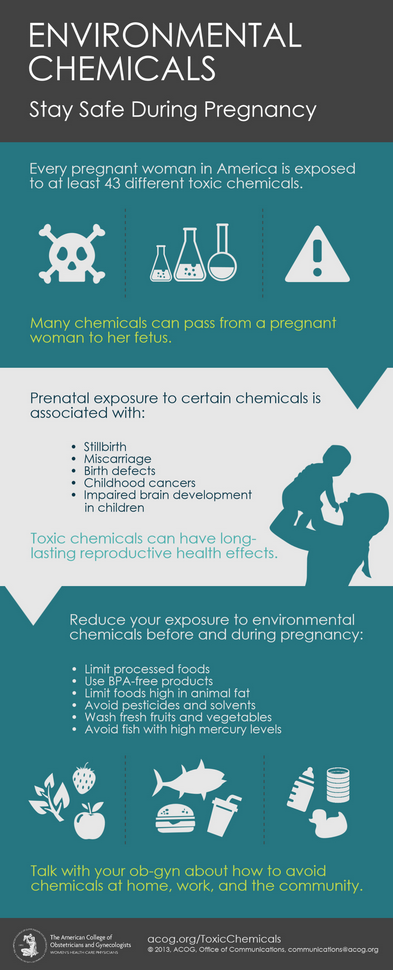
The American Congress of Obstetricians and Gynecologists (ACOG) and the American Society for Reproductive Medicine (ASRM) in a joint Committee Opinion are urging for greater advocacy in protecting pregnant women from environmental toxins. In a September 23 press release, Jeanne A. Conry, MD, PhD, president of ACOG says, “Every pregnant woman in America is exposed to many different chemicals in the environment. Prenatal exposure to certain chemicals is linked to miscarriages, stillbirths, and birth defects.”
ACOG and ASRM acknowledge that pregnant women can absorb and ingest chemicals from the environment and that these chemicals can cross the placenta and affect the health and development of the fetus. As written in the joint Committee Opinion, “Robust scientific evidence has emerged over the past 15 years, demonstrating that preconception and prenatal exposure to toxic environmental agents can have a profound and lasting effect on reproductive health across the life course (1–3). Exposure to toxic environmental agents also is implicated in increases in adverse reproductive health outcomes that emerged since World War II; these changes have occurred at a rapid rate that cannot be explained by changes in genetics alone, which occur at a slower pace.”
Some of the reproductive and health problems associated with exposure to toxic environmental agents ACOG and ASRM list are:
- Miscarriage and stillbirth
- Impaired fetal growth and low birth weight
- Preterm birth
- Childhood cancers
- Birth defects
- Cognitive/intellectual impairment
- Thyroid problems
Dr. Cory continues, “The scary fact is that we don’t have safety data on most of these chemicals even though they are everywhere—in the air, water, soil, our food supply, and everyday products,” Dr. Conry said. “Bisphenol A (BPA), a hormone disruptor, is a common toxic chemical contained in our food, packaging, and many consumer products.”
The Nine Naturals team is encouraged to see continued support for chemical reform in the face of mounting evidence that a number of commonplace chemicals are harmful for both women and their children.
Want to learn more? Read about environmental toxins and the talk our founder, Grace had with Dateline NBC here.
Want to reduce your toxic burden? Read our nine tips here.