green nurseries

  • Baby Essentials: Non-Toxic Toys

    From the moment of your baby’s birth, your parental duty is to love, nurture, teach and protect your child as they navigate this great big world. During your child’s formative years, you must make informed decisions regarding his or her health and safety, including the foods they eat, the places they visit, the toys they play with, and more.

    Were you aware that, according to PBS’ weekly news magazine NOW, the Consumer Product Safety Commission (the governmental office responsible for regulating children’s toy) can’t legally test a children’s product to determine its safety before sale? Because of this, the toys that are deemed un-safe, either as a result of perceived harm or reported injury, are removed from the shelves following either a voluntary recall from the manufacturer, or a government mandated recall (which is consistent protocol in cases where a fatality was reported).

    The experts at the Ecology Center who work tirelessly to “educate consumers to help keep their families healthy and safe,” say that parents must limit their child’s exposure to potentially harmful chemicals, many of which can be found in children’s toys and accessories, including:

    1. Phthalates
    2. PVC
    3. Tin
    4. Lead
    5. Cadmium
    6. Chlorine
    7. Arsenic
    8. Bromine
    9. Mercury
    10. BPA

    The same experts state that small amounts of the above chemicals introduced into a child’s system, whether by placing a toy in the mouth or simple skin exposure, can negatively impact a growing child’s ability to reach his or her full potential, as they are more vulnerable to the effects of toxic chemicals. Furthermore, animal studies—and a small number of human studies—have linked these chemicals to long-term health impacts, such as birth defects, impaired learning, cancer, and more.

    Before walking the aisles of your local toy store or scanning the web in search of a new toy for your child to enjoy, learn about approved baby gear brands from Healthy Child, Healthy World — a non-profit that empowers parents, influences policy and promotes solutions. The following 10 manufacturers take pride in crafting non-toxic toys made from natural materials, including solid wood (either unfinished or finished with a non-toxic coating), organic cotton, wool, and hemp. The majority of them conduct independent testing before introducing a new item to consumers.

    1. Blabla
    2. Green Toys
    3. Haba
    4. Brio
    5. Apple Park
    6. Palumba
    7. Little Tykes
    8. International Playthings
    9. Plan Toys
    10. Tiny Love

    Knowledge is power, so we encourage you to conduct your own informal research by asking fellow parents for their product suggestions, as well as keep abreast of any news regarding children’s products, especially toys and playthings.

  • Baby Essentials: Bassinets

    6 cool and comfy options to get baby (and you) through those first few months.

    Article & Photo courtesy of Well Rounded NY

    While most of us spend an endless amount of time searching for the perfect crib to anchor our nurseries, the reality is that your crib will probably just sit there collecting dust for those first few months. The adjustment period with a newborn is hard enough without having to go in and out rooms all night long. You’ll likely want your new bundle of a joy in a cozier sleep oasis right next to your bed. So before you look up one more crib, prioritize what comes first and choose the right bassinet for you. After all, it is going to be part of your room decor for a few months.

    Here are 6 of our favorites.

    1. Arm’s Reach Ideal Co-Sleeper
    The perfect option for the family who plans to co-sleep. $224.99

    2. BabyBjorn Cradle
    A breathable cradle that has the ability to gently rock your little one to sleep. $295.79

    3. Babyhome
    If you want to welcome baby into pure luxury, this one’s for you. $1,200
    (Non-leather version available for $259)

    4. Nesta’s Nest
    Made of 100% wool and eco-certified wood, this is a unique bassinet for the sustainable baby. $768

    5. Nuna Sena Mini Travel Cot
    This comfy travel cot folds up with just one hand and even transitions from a bassinet into a playard. $150

    6. Halo Bassinest Swivel Sleeper
    The only Bassinet to swivel 360 degrees for easier accessibility to your little. $250

    This article is by Kaity Velez, courtesy of Well Rounded NY. Conceived with love by former magazine editors Jessica Pallay and Kaity Velez, Well Rounded NY aims to be the singular pregnancy resource for city-savvy moms-to-be. Through reviews, profiles, expert Q&As, local guides and more, Well Rounded curates the New York City pregnancy and helps its readers come to terms – and term! – with pregnancy in the city.

  • How To Organize Your Life Before Baby

    A new baby marks big changes to the family and household. As all new parents can attest to, the bundle of joy will take up the majority of your time and energy. Sure, preparing your environment prior to your baby's arrival sounds great but trying to get organized can be more than a little overwhelming. Enter Amelia Meena, a professional lifestyle organizer and owner of New York based lifestyle organization company Appleshine. Amelia has put her spatial-design and time management skills to good use and put together a list of nine tips to help you get organized before your baby arrives.

    HOME

    Newborns live a simple life: sleep, eat, poop & repeat. So focus on organizing the Bedroom, Kitchen and Living room.

    1) Kitchen: Clear out the servingware, large dishes and other items that are infrequently used. Designate the most accessible spaces (lower drawers, cabinets above the sink and counter space) for storing, cleaning + drying the baby bottles and food containers.

    2) Bedroom: Though a baby’s life is simple, they’ll still make no less than 4 outfits changes a day. Their small clothes will get jumbled in a large drawer. Make them easy to find by using cubbies, bins or divided shelves. Labeling the sections will help others know where to put things away or find them in a pinch.

    3) Living Room: Keep a large bin or basket beside the couch for all your nursing needs. Store the Boppy, blankets, wipes and Sophie the Giraffe at arm’s length from your favorite resting spot. And pick a sophisticated style that blends with the space- let the kids’ stuff stay in the kids’ room.

    HEALTH

    You’ll do everything right for your new baby but what about yourself? Don’t forget to take care of you, too.

    4) ‘Me-Time’: Whether it’s running, yoga, meditation or a walk in the park, your body needs (and deserves!) some ‘me-time’. Plan ahead by checking the gym’s daycare center, enlisting the services of a nanny or good friend, or signing onto your favorite YouTube workout channel during naptime. Inquire before you leave for the hospital, as it’ll be easy to let it slide once you come back and feel a bit overwhelmed.

    5) Food: Most new Moms don’t have time to sit down for a full meal. Plan ahead by buying lots of easy-to-grab snacks like nuts, fruit, tuna fish, yogurt, string cheese and the like. Make a list of items that you (or a helpful friend or partner) can pick up from the grocery and nibble on all week.

    6) Outings: The simplest task will become mission impossible with a new baby. Streamline outings by keeping all your go-to items in an obvious spot, close to the front door. Plan ahead of time by creating a nook for the stroller, diaper bag, a bin of last minute items and, most importantly, a designated spot for your keys.

    HELP

    It takes a village...so starting building one now. Have a rolodex of friends and family to lean on.

    7) Workplace: Arrange your maternity leave and be clear on what timeframe and expectations that entails. Ask your co-workers if they’d be willing to help in anyway and know whom you can go to during your time away from the office.

    8) Childcare: Decide what type of childcare you’ll want and when you’ll want it. A baby nurse, a nanny, your mother or in-laws- whoever it will be, be clear about your needs, compensation and timing.

    9) Partner & Close Friends: It may be your spouse, partner, best friend or family member that’ll be your support in this exciting new step. Let them be there for you. You don’t have to do this alone. In the end, trust your heart and don’t be afraid to ask for help.

    Amelia Meena is owner of the NYC-based company Appleshine, Lifestyle Organization. As a professional organizer for a range of clients including Fortune 500 managers, lawyers, investment bankers, artists and stay at home moms, she helps people clear clutter and establish efficiency and order in their homes and their lives. Check out Appleshine for more organization tips, videos and even some ideas on how to responsible reuse or recycle your unwanted items.

  • The Toxins That Threaten Our Brains

    Screen Shot 2014-03-25 at 4.12.45 PM

    Dear Friends,

    Today I want to share with you an important article from The Atlantic. "The Toxins that Threaten Our Brain" features recent research by two experts in the fields of pediatric medicine and toxicology – Dr. Philippe Grandjean from Harvard Medical School and Dr. Philip Landrigan from Mt. Sinai School of Medicine in Manhattan.

    In late February, Grandjean and Landrigan published a paper arguing that exposure of children to industrial chemicals was responsible for a wide array of neurodevelopmental defects. They further argued that these defects are occurring with such massive, worldwide scale as to merit the label of “silent pandemic.”

    The Atlantic article highlights several interesting points about the issue of environmental toxins that we find very relevant to pregnant and new moms: 1) chemicals are omnipresent, 2) pregnancy is the most vulnerable time for exposure, and 3) the regulatory process meant to govern these chemicals is very broken.

    Omnipresent Chemicals
    Grandjean and Landrigan's research names twelve chemicals we encounter in our everyday lives, a so-called “dirty dozen”. These include some you’ve probably heard of, like lead, methylmercury and ethanol, and others that might surprise you. These substances pop up pretty much everywhere: in our couches, our cars and in our beauty products. For instance, toluene made the list, and, until recently, it was widely used to make nail polish.

    Vulnerability during Pregnancy
    The concern arises from the growing body of evidence that these chemicals affect neurological development at levels far below the “safe” limits set by the EPA. This exposure has been linked to loss of IQ points as well as a number of behavioral disorders.

    Neurological development is a delicate process; billions of cells must orchestrate themselves in space to ultimately create the most complex organ in the body - the brain. Any disturbance of the developing brain generally has permanent consequences because, physically speaking, the brain reaches its finished form by the age of two. This is why exposure to neurotoxins is so much more pernicious during pregnancy and for newborns.

    As for what you can do to reduce risk, Dr. Grandjean recommends eating organic during pregnancy when possible. This will at least minimize pesticide exposure, which is a main area of concern. However, this is not a viable long-term solution for our society.

    A Regulatory Process in Need of Reform
    The point of all this isn’t to make you panic, but rather to draw attention to the glaring faults of our regulatory process in the United States. As with any toxin “the dose makes the poison.” However, the vast majority of the 80,000 chemicals approved for use are untested, and thus we have no idea what the dangerous dose actually is.

    The EPA is almost powerless to fully ban a substance – it’s happened just 5 times out of 20,000 cases since the current legislation was put in place. This is why large-scale reform is needed. Dr. Grandjean suggests requiring at least basic testing of new products in order to identify those that need more involved safety research. He also points to the European system that requires more testing for substances that are more widely used as a very reasonable solution. But all of this will require action, and thus far we have failed to keep up with the science. Until we do, it’s critical that expecting mothers do what they can to minimize exposure.

    ****

    At Nine Naturals our mission is to make beauty safe and simple for moms-to-be. We feel that education is the first step in this process and that research like this must be shared. This information empowers us to protect ourselves, our families and our futures. (The Atlantic).

    Please share this article with your friends!


    Grace
    CEO, Founder Nine Naturals

  • Save on Baby’s First-Year Gear

    piggy-banks-624x208

    Article & Photo Courtesy of Well Rounded NY

    Well Rounded NY's new personal finance contributor, Jennifer Saranow Schultz, gives us 7 ways to cut costs in Year One.

    As 2014 kicks off, many urban parents have one major New Year’s resolution: cut spending. In fact, according to a recent survey from UrbanSitter, a site that helps city parents find babysitters, “spend less, save more” is officially one of mom and dads’ top New Year’s resolutions.

    This is hardly a shock considering that living in the city isn’t cheap, especially when you add a new baby into the mix. According to the book Baby Bargains, baby gear (from cribs to clothes to car seats) for the first year alone can run at least $7,000 on average.

    The good news, however, is that there are seven simple strategies new and soon-to-be parents can do to cut down the costs of raising a baby from birth to age one, so there’s at least some disposable income leftover to enjoy all that city life has to offer. And perhaps even save.

    Pick your gear wisely.

    1.) Skip waste-of-money baby products. Consult baby store sample baby registries and the amount of baby gear you need can seem overwhelming. The truth is, however, that you don’t really need many of the items on such lists. Wipe warmers, fancy baby thermometers, crib bedding sets and bottle sterilizers are just some of the gear items on my waste-of-money list.

    2.) Register for the basics. As I’ve mentioned before, I’m a big fan of registering for the basics and for the items that you really need (like a car seat and stroller), so you’ll get baby gifts that you’ll actually use. On my baby registry, for instance, I included strollers, car seats and necessities like diapers, baby shampoo, diaper rash cream and basic white onesies.

    3.) Buy the right gear the first time. Take the time to research and figure out the particular gear (from car seats to strollers to baby carriers) that will work best for your particular lifestyle, so you’re not wasting money on replacement items. For instance, if you take taxis a lot, the car seat you’ll want to get is different from the ones that would work best if you only drive or walk around the city.

    Meanwhile, for those looking to cut costs, the right gear is often that which has the longest useful life and can have other purposes down the road. This is why I say go for an Exersaucer rather than a jumperoo, swaddle blankets that can work as crib rail guards, high chairs that are more like booster seats, and strollers that double as nighttime bassinets.

    So where to can you do this kind of research? Good starting points include the book Baby Bargains, basically the Consumer Reports of baby gear; and sites like WeeSpring , Well Rounded NY (obviously) and (shameless plug alert) Hint Mama.

    Rely on your network.

    4.) Say “yes” to a baby shower. As John Schmoll recently suggested on U.S. News’ My Money blog, if friends or family ask if they can throw you a shower, say “yes” without any hesitation. You’ll need all the financial help you can get amassing the necessary baby gear.

    5.) Take – and ask for – hand me downs. If you’re lucky enough to have experienced parents as relatives or friends, don’t be bashful about saying “yes” if they offer to let you borrow – or even keep – their used baby gear. In addition, don’t be ashamed to outright ask if they have anything to lend (when it comes to baby gear, the shameless person wins the saving money game). The experienced parents you know probably don’t have room to store all their gear at their place (small or nonexistent city storage spaces anyone) or don’t plan on using it again.

    To be sure, you’ll want to avoid accepting hand-me-down cribs or car seats unless you know their exact history and are sure they’re still safe to use (this is why I prefer hand-me-downs from people I know rather than buying such gear used from strangers). You’ll also want to look over any hand-me-down toys or clothes to make sure they are in good, and age-appropriate, condition (stay tuned for more on what’s okay – and not okay – to accept, and buy, used in a future post).

    Don’t pay full price when you don’t have to.

    6.) Local moms groups are your friend. Moms groups (like the Golden Gate Mothers Group in San Francisco, where I live, and Park Slope Parents in Brooklyn) offer members discounts at various gear vendors.

    7.) Clip your coupons. Always search online for discount codes before you make any big purchase, and if you’re going to make most of your purchases at certain stores, don’t forget to join the loyalty clubs. Finally, take advantage of big retail sale events like Cyber Monday.

    What are your tricks for cutting down the costs of baby gear?

    Image source.

    This article is by Jennifer Sarandon Schultz courtesy of Well Rounded NY. Conceived with love by former magazine editors Jessica Pallay and Kaity Velez, Well Rounded NY aims to be the singular pregnancy resource for city-savvy moms-to-be. Through reviews, profiles, expert Q&As, local guides and more, Well Rounded curates the New York City pregnancy and helps its readers come to terms – and term! – with pregnancy in the city.

    Jennifer Saranow Schultz (aka Hint Mama and our new resident personal finance contributor) is a writer based in San Francisco, where she lives with her toddler and husband. She’s the founder of HintMama.com, a new blog where she’s reporting the best hints she comes across for making parenting easier and cheaper.Before entering the corporate world two years ago, she was the lead writer for The New York Times “Bucks” personal finance blog from 2009 to 2011. Previously, she spent seven years as a reporter at The Wall Street Journal, and she has written for other publications including The Daily Beast, Marie Claire and Living on the Cheap. You can find her daily hints at HintMama.com, and she can be followed on Twitter at @HintMama and on Facebook at Facebook.com/HintMama.

  • Keep Formaldehyde Out Of Indoor Air

    Formaldehyde out of Indoor Air


    Formaldehyde has been classified as a known human carcinogen by the International Agency for Research on Cancer and as a probable human carcinogen by the U.S. Environmental Protection Agency. It also happens to be a common indoor air pollutant emitted by many of the following: plywood, particleboard, fiberboard; and other pressed-wood products; carpet and carpet glues; paint and floor finish; foam insulation; fiberglass; permanent press clothing and draperies; air fresheners; and even fingernail polish and hardener.

    The levels of formaldehyde typically found in indoor air are too low to be smelled but often high enough to cause toxic effects for both children and adults, especially if exposure is ongoing. Short-term exposures can cause allergic skin and mucous membrane reactions, flu-like symptoms, and asthma and other respiratory problems. Formaldehyde has also been linked to nose and throat cancers, and leukemia.

    Keeping formaldehyde out of your home’s and your children’s environment is largely a matter of avoiding products that emit it. This can be difficult where construction materials are concerned—it’s often not feasible, for example, to remove existing insulation, carpet or plywood. Formaldehyde emissions from products that contain it, however, generally diminish to negligible or nonexistent levels over time and so are usually only problematic when new.

    Here’s how to protect your children and keep your home’s air clear of formaldehyde:

    • Buy only solid-wood products not those made of pressed woods, which can be identified by looking at an unfinished or cut end, or under upholstery. Pressed-woods will look like wood chips, sawdust, or layers glued together.
    • Seal newer unfinished pressed-wood items with formaldehyde-free paint, varnish, or water-based polyurethane sealant.
    • When installing carpet, insist on mechanical methods like tacks instead of glues.
    • Don’t use synthetic air freshening products, especially around your children.
    • Skip the nail polishes and hardeners. (Even formaldehyde-free versions frequently contain other potentially toxic hazards.)
    • Read labels on building products, cleaners, and cosmetics. Look for formaldehyde, urea formaldehyde, or phenol formaldehyde. Be aware that not all products containing formaldehyde will list it on their labels. Consult the manufacturer and use natural alternatives whenever possible as a precaution.
    • Ventilate! Open windows and use fans and air conditioning to reduce formaldehyde concentrations.
    • Wash new clothing and bedding before use to remove fabric finishes. Don’t purchase permanent press or other treated fabrics. Air out new textiles you suspect may be treated for a week before installation in a garage or another covered outdoor spot.

    This article is courtesy of Healthy Child Healthy World. For the past 20 years, our friends at Healthy Child Healthy World have provided access to critical information that encourages smarter lifestyle choices to reduce toxic chemical exposure in homes and communities to become a trusted resource for parents. Healthy Child’s vision is a world where every child has the opportunity to grow-up in a healthy and safe environment.

  • Nine Naturals Featured in the HCHW "Shop Healthy" Pocket Guide!

    Our partner Healthy Child Healthy World has put together a "Shop Healthy" pocket guide featuring trusted brands (including Nine Naturals!) that cover everything from personal care, baby gear to household cleaning. It's easy, simple, and fits right in your pocket or wallet!

    Download it here: http://bit.ly/1eQGob8

    Untitled


  • Things We’ve Read – Week of December 2nd

    Pregnancy

    Prenatal Depression: What I Didn’t Expect When I Was Expecting (NYTimes): An enlightening recounting of sadness during pregnancy. Sometimes, placenta doesn’t produce enough progesterone; this offset causes symptoms of depression.

    Fertility Doctors Aim To Lower Rate Of Twin Births (NPR): Big multiple births (like Octomom) have decreased but the twin rate is stagnant. Doctors want to lower the rate of twin births and increase the rate of healthy, live births.

    The Toxins That Affected Your Great-Grandparents Could Be In Your Genes (Smithsonian): An interesting study of the staying power of toxins finds evidence of hardy and insidious chemicals 4 generations after exposure.

    Breathe easy by avoiding chemicals in home items (Philly.com): Is your house off-gassing? Probably. That's what happens when chemical substances evaporate and get into the indoor air.Screen Shot 2013-12-08 at 2.51.18 PM

    Dandruff Shampoo could Mess up Waterways (Scientific American): A study has detected fungicides from anti-dandruff shampoos in the water. They retard the growth of larger plants which offsets the ecosystem and deprives marine animals of food.

  • Creating a Green Nursery ... a Healthy Space for your Newborn!

    Every mom wants to create a beautiful nursery for her new baby. It’s one of the first physical gifts we as parents give our child and we want it to be as much a manifestation of adoration as four walls can muster.
    We at Nine Naturals know the feeling. We also want to help new parents create a nursery that is as safe as it is stylish.
    Make it organic? Sure, but let’s be more specific. Setting up a green nursery is not just about following the organic trend. It’s a way of helping to ensure your baby’s health and well-being in his or her earliest years.
    Nine Naturals’ recommendations for a truly green and safe nursery:
    1. Keep the room ventilated! An unseen threat to a green nursery is the presence of VOCs, or volatile organic compounds, which are released (or “off-gassed”) by thousands of products. These compounds are used to help paint spread and eventually dry. VOCs pose long-term risks to human health and the environment. And although VOCs are everywhere, it’s indoor air that tends to have higher concentrations of VOCs. Remember to avoid VOCs at all costs, especially in your little one’s new room.
    2. Avoid exposure to harsh fumes that can emerge from traditional paints and lack of air flow. Avoid major home renovations during pregnancy, which can increase chemical exposures, or try to avoid being in the house during the work. Purchase no-VOC paints, and ensure that the future nursery has excellent ventilation — particularly while it’s being painted.
    3. If you must use carpets, be very, very picky. Carpets can serve as home to allergens and dust mites. Further, many synthetic carpets are made with latex backings, and these backings as well as the adhesive used to affix them to floors can release VOCs by “off-gassing.” Looking for an alternative? Try a rug made of natural fibers like wool or cotton that does not come with a synthetic backing.
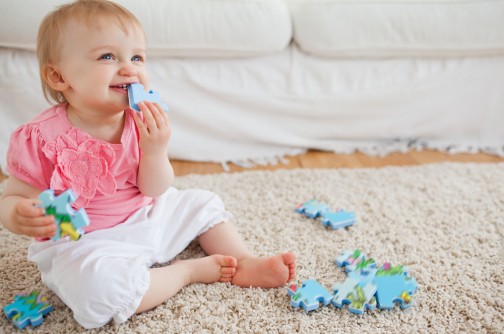
    4. Buy toys made from natural materials. Ensure that all of your baby’s toys are nontoxic, non-PVC, non-BPA and non-phthalate. In other words, look for toys made of natural materials such as wood or silicone. Before you know it, your baby will be sucking and teething on everything in sight. PVCs can leach harmful phthalates, and BPA (bisphenol-A) can also impact your baby’s long-term well being. We prefer toys made from organic cotton and sustainable wood. Check out Plan Toys for some great options.
    5. Choose organic or natural fiber bedding. Why? Your baby is going to spend a large part of his or her early years sleeping in a crib. Most crib mattresses on the market contain toxic chemical fire retardants, which have been associated with many health issues. Organic cotton, natural wool, or bamboo mattresses and bedding are friendly to both the environment and your baby’s skin. We like brands like Nook and Naturepedic.
    6. Purchase a crib and baby furniture sourced from certified sustainable or reclaimable materials. Ideal furniture pieces also completely avoid the use of VOC’s and formaldehyde – not only in their wood, but also in their paint, glue, and or resin. Take a look at beautiful designs from Oeuf and Duc Duc or for a cheaper alternative, consider Ikea.
    7. Opt for all-natural, nontoxic, and chemical-free cleaning supplies to maintain a tidy green nursery. You should be able to read and understand, simply from the label, every single ingredient that your cleaning products contain. Green products are environmentally sustainable and their ingredients are safe for your baby to touch or inhale. Our founder Grace uses Dapple in her daughter's nursery.
    8. The same principles apply to other baby needs like clothing and diapers. You spent nine months making a natural environment for your growing baby in the womb - keep it up in their nursery!

    What tips would you add to our list for the ideal green nursery?

9 Item(s)