






Posts Tagged ‘Breastmilk’

Minimizing Toxins While Breastfeeding

BreastFeeding_060713-617x416

Breastfeeding provides a growing baby with numerous health advantages. Breastmilk’s natural ingredients include protein (whey, casein, and other baby-friendly proteins), fats, vitamins, and lactose, in addition to infection-fighting leukocytes (APA).

If you are considering breastfeeding, it’s a wonderful option. Science Daily, for example, discusses PSTI (pancreatic secretory tripsin inhibitor) which reinforces and strengthens the lining of newborns’ intestines. Leukocytes, which battle illness in babies, also only exist in breastmilk. Nursing could also go so far as to improve baby’s genes in ways that safeguard an infant’s immune system.

However, it behooves moms and their babies to also understand that healthy nutrients aren’t all that can transfer via breastmilk from mother to baby. What you eat, drink, or use for your bodycare during pregnancy and nursing can contaminate your breastmilk and expose your baby to risk. Florence Williams, acclaimed author of “Breasts,” wrote in a 2005 NYT article about how toxins can transfer from mother to baby via the breastmilk. Women in their child-bearing years may have unknowingly developed a “chemical burden,” or buildup of harmful compounds:

When we nurse our babies, we feed them not only the fats, sugars and proteins that fire their immune systems, metabolisms and cerebral synapses. We also feed them, albeit in minuscule amounts, paint thinners, dry-cleaning fluids, wood preservatives, toilet deodorizers, cosmetic additives, gasoline byproducts, rocket fuel, termite poisons, fungicides and flame retardants. -Williams

This should not discourage mothers who wish to breastfeed - but rather should make them more judicious about their exposure to chemical toxins during pregnancy and nursing. What you put into and onto your body counts in the pursuit of a healthy body for both you and your baby. Keep that truth in mind when selecting which products to incorporate into your skincare and haircare regimens.

Women should look after themselves during nursing as carefully as they do during pregnancy. Here are a few tips to accomplish just that, while avoiding exposure to toxins where possible:

  • Use chemical-free, natural products. Research and stick to beauty lines such as our very own Nine Naturals.
  • Read product labels closely. Learn how to recognize variations of harmful chemicals as phthalates and sulfates.
  • Eat organic. Make organic food choices that optimize your nutrient sources and minimize chemical exposure, like pesticides.
  • Steer clear of second hand smoke. You obviously know not to smoke at all while pregnant. Research also proves that cigarette and marijuana smoke can subject your infant to risk of SIDS and stunted growth and development.
  • Avoid synthetic fragrances. They’re riddled with toxins and can enter your body through your respiratory system and through your skin.
  • Inform your physician of any and all medications. From aspirin to acne cream, even the most innocuous medication can cause harm to your body and your baby’s body while nursing. Have a detailed discussion with your pediatrician and / or obstetrician to go over which meds are safest and which are risky.

Want to learn more about preparing for breastfeeding? Read our Top 5 Tips on how to Prepare for Breastfeeding and Top Breastfeeding Gear from Expert Lactation Consultant Sheridan Ross. Also checkout our Nine Ways to Reduce Your Toxic Burden During Pregnancy.

We wish you a wonderful experience with your newborn. As always, we encourage you to keep your body healthy through pregnancy, breastfeeding and beyond. Because taking care of yourself is the best thing you can do for your baby - especially during this special time in the baby’s development.

Top Breastfeeding Gear from Expert Lactation Consultant, Sheridan Ross

Top Breastfeeding Essentials

As part of Breastfeeding Awareness Month, we sat down with expert lactation consultant, Sheridan Ross of Baby Sips, to learn more about what breastfeeding gear to purchase ahead of the baby arriving. There are great products out there that will help to make breastfeeding a smoother and more comfortable - especially in the beginning as you’re just getting a handle on it. Here are Sheridan’s recommendations for Top Breastfeeding Gear to purchase before the baby arrives:

  1. Mommy’s comfort is imperative! That doesn’t mean go out and buy a giant glider, though. Move around your home and see what you’ve already got “in stock”. What use to qualify was your cushy recliner, but with a newborn and donut pillow it might be the last thing you want to sit on while breastfeeding. Not too deep, not too soft, not too narrow (I sound like Goldilocks). You need to be able to relax but be supported and comfortable. Locate that place before you bring home your baby so you know where to go when it’s time to feed. As you get into a rhythm with nursing, these might change.
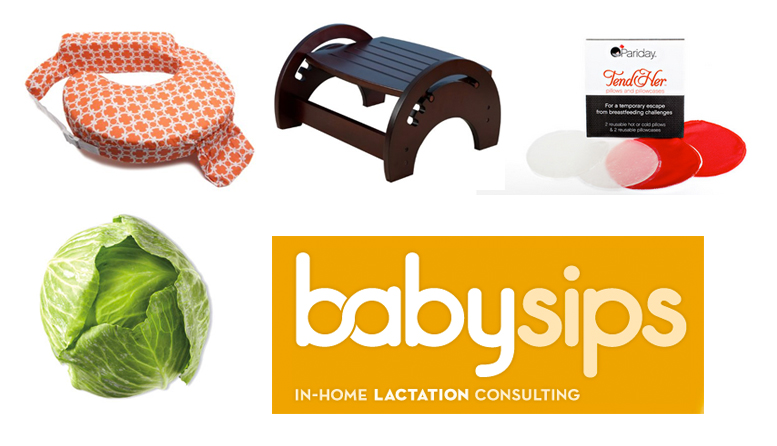
  2. Nursing Pillows. I’m a huge fan of the My Brest Friend. It gives fantastic lumbar support and gets up nice and close to you. Firm pillow top allows you to use more pillow support and less upper body strength when nursing.
  3. Nursing Foot Stool. This might seem like a frivolous purchase, but I promise you, the ottoman from the front room will not work. The nursing stool is just a few inches off the ground, usually at the correct angle for your feet and it’s wonderful. It brings your lower back into a neutral position (no back aches, no strain), knees come up a little offering additional support under your MBF pillow. I’ve seen it make a huge difference for many nursing mommas.
  4. Pariday TendHer Pillows. These are the greatest things since sliced bread. Filled with a non-toxic vegetarian food-based gel inside a deliciously soft safe plastic pouch (BPA + phthalate free), they last for FOUR WEEKS. Not 72 hours. Not 6 days. 4 weeks. And they maintain their “feel good” status the entire time. Use them warm, cold, room temp – it all works. That means less waste and multiple uses! Sore nipples, inflamed areola, plugged ducts, plugged nipple pores, engorgement, headache, cramps, early teething comfort, boo-boos, and more. They come with pillowcases to help wick away milk and prevent leaking on clothing. Once you hold them in your hand they’re hard to put down.
  5. Green Cabbage for engorgement. You don’t eat it; you WEAR it. Here’s how to use it properly:
  • Buy a head of common green cabbage.
  • Remove the core and carefully peel individual leaves from the head of cabbage.
  • Wash the leaves, pat them dry, and pop them into the fridge – cooling provides more comfort.
  • Choose your leaves and roll them with a rolling pin (or a similar object) to break up the fibers.
  • Gently place the leaves around the engorgement of your breast (not the areola or nipple), and possibly up into the swollen area under your arms; and wear a light supportive bra (no underwire!) for at least one hour. By this time the leaves should be wilted.
  • Discard the wilted leaves.
  • Repeat the process every 4-6 hours until the engorgement subsides.

You might feel like a walking salad but it’s better than feeling like a walking zombie!

Why Cabbage? Cabbage has a natural anti-inflammatory effect when used for a short period of time; however, it should not impact your supply if you’re constantly removing milk by nursing or pumping. When using cabbage for an extended period of time, without milk removal or breast stimulation, it can impact your milk supply – consider it a good tool again when you’re ready to wean.

If the road starts to get bumpy, then call for support. If you’re having pain from the start, call for support. If you’re a first time mommy or this is your seventh child, this new baby has never nursed before so be patient while you figure it out together. There’s a bit of a learning curve so have your “village” help with the house, laundry, and cooking, and call your IBCLC. You won’t be sorry.

Want to learn more about breastfeeding? Read Sheridan’s Top Five Tips on How to Prepare for Breastfeeding.

Sheridan Ross is a skilled and compassionate lactation consultant who provides counseling, education and support to moms at every stage. Sheridan is internationally board certified and received her education from UC San Diego and Health e-Learning’s Breast-Ed Series from Australia. She is a member of ILCA (International Lactation Consultants Association), USLCA (United States Lactation Consultants Association), and BALA (Bay Area Lactation Association).

Sheridan has worked as a lactation consultant at Healthy Horizon’s Breastfeeding Center, at the Family Birth Center in Mills-Peninsula Hospital, and is on staff at Bay Area Fertility & Pregnancy Specialists and Pediatrics. She regularly teaches breastfeeding classes, infant massage classes, and hosts support groups. Sheridan’s commitment to infant health and wellbeing extends to her additional roles as a labor doula, certified massage therapist with a focus on prenatal massage, and as a certified instructor of infant massage. For more information, please go to: www.babysips.com or 650-BABYSIPs (650-222-9747).

Before the Baby Arrives, Top Five Tips on How to Prepare for Breastfeeding

Sheridan Ross, Licensed Lactation Consultant and Founder of Baby Sips, tells us how to “prepare, deliver and conquer”.

How will I know my baby is getting enough? What if I can’t produce an adequate amount of milk? Is it true I need to “rough” up my nipples to prepare for breastfeeding? If you’re planning to breastfeed, these are just a couple of the questions that have likely raced around your brain. Taking the time to learn the answers now will help you get breastfeeding off to a great start and will allow you to approach it with confidence.

I continually observe families devoting the majority of their pregnancy to learning how to give birth, with several weeks of breathing, effleurage, and squatting on a yoga ball. Breastfeeding education can sometimes be an after thought. The funny thing is breastfeeding lasts much longer than the labor and delivery! Don’t get me wrong, it’s good to get prepared for birth, but I highly encourage you to spend more time on the post delivery. Think about it: you’ll be feeding your newborn(s) every 1.5-3hrs around the clock. Not sure if you heard me: AROUND THE CLOCK. Daily. Nightly. Afternoonly. It doesn’t stop, so taking the time to wrap your head around it before your little one makes their debut is a great idea.

Here are my Top 5 Tips:

1. Find a few local prenatal breastfeeding classes and investigate.

  • What makes them worth your time and/or money?
  • Is it educational, supportive, non-judgmental, and fun?
  • Do they encourage partners to attend?
  • Do they provide a superbill so you can try to apply for reimbursement from your insurance company? *this is new and LC’s are working really hard to help make this happen*

2. Read some books – you should still have time for that, right? You’ll see that I have a favorite…

  • The Nursing Mother’s Companion – Kathleen Huggins
  • The Latch and other Keys to Breastfeeding – Dr. Jack Newman
  • The Womanly Art of Breastfeeding – LaLeche League
  • The Ultimate Breastfeeding Book of Answers – Dr. Jack Newman
  • Breastfeeding Made Simple – Nancy Mohrbacher, IBCLC
  • Dr. Jack Newman’s Guide to Breastfeeding – Dr. Jack Newman

3. Watch some DVD’s

  • Happiest Baby on the Block – Dr. Harvey Karp
  • Dr. Jack Newman’s Visual Guide to Breastfeeding – Dr. Jack Newman
  • BabyBabyOhBaby’s Breastfeeding – David Stark (this video makes me cry every time I watch it)

4. Attend a local Breastfeeding Support Group

  • This is wonderful to do while pregnant. The women who attend are always excited to see you and you’re able to get some real-world info on what’s going on in the many stages of baby development and behavior. Bring your partner!

5. Find a local IBCLC (Internationally Board Certified Lactation Consultant) in your area and put them on speed dial.

  • Interview a couple of them and see who resonates with you – sort of like choosing a Doula. You want someone who will be supportive and nurturing without adding guilt or pressure to the mix.
  • What is their philosophy and are they interested in hearing yours? Do they listen?
  • Does your Midwife have breastfeeding experience? Your Doula? Does your birthing center or hospital have IBCLC’s available? How much time do they typically spend with patients?

If the road starts to get bumpy, then call for support. If you’re having pain from the start, call for support. If you’re a first time mommy or this is your seventh child, this new baby has never nursed before so be patient while you figure it out together. There’s a bit of a learning curve so have your “village” help with the house, laundry, and cooking, and call your IBCLC. You won’t be sorry.

Sheridan Ross is a skilled and compassionate lactation consultant who provides counseling, education and support to moms at every stage. Sheridan is internationally board certified and received her education from UC San Diego and Health e-Learning’s Breast-Ed Series from Australia. She is a member of ILCA (International Lactation Consultants Association), USLCA (United States Lactation Consultants Association), and BALA (Bay Area Lactation Association).

Sheridan has worked as a lactation consultant at Healthy Horizon’s Breastfeeding Center, at the Family Birth Center in Mills-Peninsula Hospital, and is on staff at Bay Area Fertility & Pregnancy Specialists and Pediatrics. She regularly teaches breastfeeding classes, infant massage classes, and hosts support groups. Sheridan’s commitment to infant health and wellbeing extends to her additional roles as a labor doula, certified massage therapist with a focus on prenatal massage, and as a certified instructor of infant massage. For more information, please go to: www.babysips.com or 650-BABYSIPs (650-222-9747).

Making the Switch to a Greener Lifestyle

Many women wonder about the best time to get healthy, in anticipation of a baby. Is it ever too early or too late to make changes to your lifestyle towards greener, healthier habits? Should you examine your lifestyle while conceiving? Is it OK to wait until the moment the pregnancy test reads, “YES?” Or is a switch to healthy living most effective once your infant is born?

Understanding the nature of environmental toxins and your baby’s development can help provide you an answer.

Toxic Burden

Consider “toxic burden,” or the sum of toxic chemicals that accumulate in your body over time. Planet Earth is not sterile; it’s impossible to completely avoid exposure to harmful compounds. You can exacerbate your toxic burden, however, with the use of certain beauty products, artificial foods, and other chemical-laden products. Women, especially those considering pregnancy, should be aware of toxic burden’s cumulative effect on the body over time. By simple virtue of living on a planet rife with harmful compounds, your blood stream has likely already built up levels of chemicals — at least 700 of such — that tax and harm your health. No body, pregnant or otherwise, starts a period of cleansing from a chemically blank state.[1]

Chemical Exposures in the Womb

Mothers-to-be should remember how actions in their own bodies impact their infants’ health. This holds truth when baby is in the womb, with mother’s nutrients and processes literally informing how well or poorly her child grows. Importantly, via the placenta, pregnant women may pass on chemicals they are exposed to during pregnancy to their developing babies.

The placenta fortunately does filter a few toxins. Yet by no means does it completely eradicate every contaminant from the pregnant body. Says a report from the Mt. Sinai Children’s Environmental Health Center, “[cases involving] infants exposed in the womb to thalidomide [and] di-ethyl stilbestrol… destroyed forever the myth of the invulnerable placenta.”[2]

Taking Care of Baby After Birth

Your body also influences your baby post-delivery. Breastmilk, for instance, can carry both crucial nutritive compounds and your body’s toxins along with it. Let’s say you’d prefer not to breastfeed. Does this spell the end of your body’s influence on your baby? The answer is a resounding no. Children’s development responds to both genetics and their environment. For nine months, your belly provided for your baby. Beyond pregnancy, your surroundings still exert a major impact. The World Health Organization clarifies:

“During early childhood (from the prenatal period to eight years of age), children undergo rapid growth that is highly influenced by their environment. Many challenges faced by adults, such as… obesity [and] heart disease… can be traced back to early childhood.”

The Time is Now

Invest in your future child’s health now by deciding to implement, and maintain, a toxin-free lifestyle. Today is the perfect occasion to begin a switch to wellness. Your health directly reflects onto your child. Why wait one more day to protect him or her? Have you done anything to safeguard your family from the toxins that encircle them?

Read our safe pregnancy tips to reducing your chemical load during your nine months.


[1] Chemical Body Burden. What is Body Burden? Retrieved from http://www.chemicalbodyburden.org/whatisbb.htm.

[2] Landrigan, P. 2010. Exploring the Environmental Causes of Autism and Learning Disabilities, pg.8. Mt. Sinai Children’s Environmental Health Center.