Tag Archives: language learning

  • Baby Socialization

    Babies start learning earlier than you think, especially from each other.
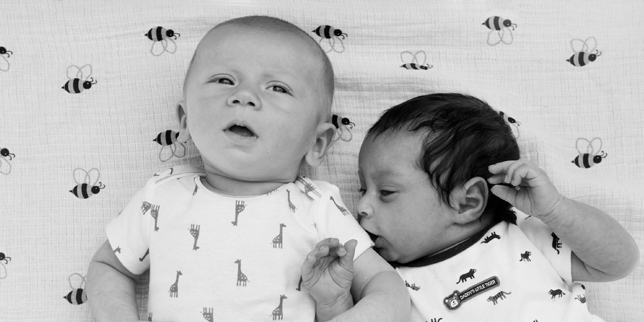
    baby socialization

    Article & Photo courtesy of Well Rounded NY

    Have you ever seen a baby discover another baby? It’s amazing.

    Take two 6-month-olds and place them on their backs next to each other. Almost instantaneously, they realize they aren’t alone and like two mini-people, magnetically they become drawn to each other.

    With a slight move from the back to tummy, one baby will catch sight of the other. Soon enough, the babies are moving closer to each other for a better look. This leads to touching a face, reaching for a hand, catching a glance. In short, starting a friendship fueled by a natural desire to be with people and find a connection. All this happens very soon after birth–as if we are hard wired to become friends.

    Before I became a parent and a teacher, I thought that socializing began as children entered the preschool years. Of course, I realized that babies smiled at parents and grandparents, were interested in adult faces and loved hearing people talk to them. What I didn’t realize is that babies are fascinated with other babies and that social interactions from birth can have a significant impact on a child’s social development and how they relate to others.

    Here’s 5 benefits of social interaction between babies.

    1. Social development. Long ago Jean Piaget introduced stages of social development that unfolded over time and came to fruition as children produced language and the skills of symbolic play (using a block to represent a telephone or developing the ability to step into a pretend scenario). These stages of social development in children start first with babies playing alone and being unaware of others. Next, children are side by side but still largely play independently. Finally, the third stage has children working and playing cooperatively with shared goals.
    1. Language. Lev Vygotsky, another child development expert, posited that play evolved along with language development. Children’s language and cognition, he said, grew side by side to foster increasingly robust play.
    1. Intentional actions, like crawling or reaching for a toy. When an infant of three months discovers her hands, becomes fixated on how they work, what they can do and ultimately how they can be harnessed for intentional action, we can easily miss the point. In discovering their hands, our baby has found their first toy. Similarly, a baby who is fascinated by another’s face or is eager to crawl towards a creature like herself is exhibiting rudimentary social awareness. It is literally their first step in developing connections with others. We see this attraction when babies look at books of baby faces. But just imagine how much more alluring—and rewarding—it is when that baby is next to them in the flesh!
    1. Pleasure. Children who are exposed to other children during infancy have a greater opportunity to discover themselves in relation to others. They also come to see other baby faces as a source of pleasure.
    1. Connections to each other. While it is clear that play deepens and changes as children develop their expressive and cognitive capacities to reveal what they imagine, it seems equally clear that babies are related to other babies in a special way. And we shouldn’t dismiss this connection simply because it remains mysterious. Learning to notice another, being attracted, reaching outside oneself to explore another’s face or hands—all of these are stepping stones to stepping stones that open the door to play.

    Social learning centers, where teachers guide interactions, are perfect settings for this journey of discovering the self in relation to others. Social learning environments give children a solid start in the domains of social and emotional development, which are key to all future learning and, more importantly, lasting happiness.

    This article is by Renee Bock, courtesy of Well Rounded NY. Conceived with love by former magazine editors Jessica Pallay and Kaity Velez, Well Rounded NY aims to be the singular pregnancy resource for city-savvy moms-to-be. Through reviews, profiles, expert Q&As, local guides and more, Well Rounded curates the New York City pregnancy and helps its readers come to terms – and term! – with pregnancy in the city.

  • Are Words Enough?

    Doing more to close the Million-Word Gap.

    Article & Photo courtesy of Well Rounded NY

    Over the past year, there’s been a lot of talk about the “word gap,” the unequal number of words children of different economic backgrounds hear each day. We know that the linguistic divide represents an inequality that lasts into adulthood. Over and over again, we have cited the number of words as a key factor in children’s lifelong success, their ability to read, communicate thoughts, process information, etc. The disparity has always seemed quantifiable, something we could easily wrap our brains around as we strive to give children lots of words, the earlier the better.

    However, as a mother of three children and a lifelong early childhood educator, the idea of filling the million word gap with endless adult-generated talk aimed at children always struck me as overly simplistic and even invasive. Emphasizing the quantity rather than quality of interaction presented an intrusion into the child’s inner life, almost undermining their right to make meaning and drive their learning.

    During a recent Harvard symposium on The Leading Edge in Early Childhood Education to examine how to improve children’s early education–including closing the word gap–I got to hear from Kathy Hirsch-Pasek, professor of Psychology at Temple University and an expert on language development. She specifically addressed what kind of talk matters and why. She shared the following excerpt from a study called How Do Families Matter produced by The Foundation for Child Development in 2009:

    The Eggplant Parable

    A mom is at the supermarket with her young child who notices an eggplant. “Mommy, what’s that?” asks the child. The response is as follows:

    Mother #1: Shushes her child and ignores the question.

    Mother #2: “That’s an eggplant. We don’t eat it.”

    Mother #3: “Oh, that’s an eggplant. It’s one of the few purple vegetables.” She picks it up, hands it to her son, and encourages him to put it on the scale. “Oh, look, it’s about two pounds!” she says. “And it’s $1.99 a pound, so that would cost just about $4. That’s a bit pricey, but you like veal parmesan, and eggplant parmesan is delicious too. You’ll love it. Let’s buy one, take it home, cut it open. We’ll make a dish together.”

    Mother #3 is doing everything possible to fill the word gap, not simply in the number of words she provides, but also by sharing the child’s interest, creating language in a meaningful context, and providing the vocabulary and grammar reciprocally. She offers a layered response that enthusiastically expands the child’s world knowledge—providing a nuanced description of the object (purple, heavy, and expensive). She then reminds the child of past experiences: You like veal so you might like this. And then she follows up with what will happen next: We’ll buy it, cut it open and make it together. This is a deep interaction, an example of shared attention between two human beings.

    Hirsch-Pasek’s research expands the conversation around the million word gap, and she provides six principles of engagement that we can all apply to help us behave more like Mother #3:

    1. Children learn what they hear most
    2. Children learn words for things and events that interest them
    3. Interactive and responsive environments build language learning
    4. Children learn best in meaningful contexts
    5. Children need to hear diverse examples of words and language structures
    6. Vocabulary and grammatical development are reciprocal processes

    Doing things together such as cooking, making art, going to a museum, walking in the park, reading books and singing songs all provide meaningful language experiences within a loving context. Whether at home or in a high quality educational environment, children have a right to thoughtful language exchanges that build a sense of self, self-esteem, strong attachments to adults and friendships with children.

    This article is by Renee Bock, courtesy of Well Rounded NY. Conceived with love by former magazine editors Jessica Pallay and Kaity Velez, Well Rounded NY aims to be the singular pregnancy resource for city-savvy moms-to-be. Through reviews, profiles, expert Q&As, local guides and more, Well Rounded curates the New York City pregnancy and helps its readers come to terms – and term! – with pregnancy in the city.

2 Item(s)